
Highland Resident Record Coverage
No single Highland roll answers every identity question. Property records name a recorded owner, not each person in a home. A court index can show that a similarly named party appears in a public case, but it cannot by itself prove present residence. Voter tools confirm an individual registration match, subject to protected-record rules. A reliable resident lookup selects the record that fits the question, then checks the result against a second source.
| Record | What It Can Confirm | Official Keeper | Access Route |
|---|---|---|---|
| Parcel card | Recorded owner, situs, mailing address, class | Lake XSoft | Free owner, address, property-ID, or broad text search |
| Deed or plat | Transfer parties and legal parcel continuity | Lake County Recorder | Account-gated portal or recorder office |
| Voter record | Individual registration match and polling information | IndianaVoters | Name, birth date, and Lake County lookup |
| Court case | Public parties, case status, docket, and available filings | Indiana MyCase | Free search, Clerk for certified or missing files |
| Vital or marriage record | A qualifying birth, death, or marriage event | Lake Health or Lake Clerk | Application, proof, fee, and eligibility rules |
| Obituary or yearbook | Dated family, school, or place connection | Lake County Public Library | Indexes, databases, microfilm, and staff help |
| Business or license | Public entity role or state credential | INBiz or Indiana PLA | Free public search; affiliation is not residence |
Start with the most exact fact already known. An address points toward XSoft and deeds. A case number belongs in MyCase or the Clerk's system. A death date can lead to an obituary, probate file, or eligible death-certificate request. Keep the source date beside every result, since a court filing, tax card, and obituary may describe different years.
Search Highland Names in MyCase
Highland has no separate municipal court in the official Odyssey court list. Public Lake County cases instead appear through the county courts and Indiana's statewide systems. MyCase search tips allow a party search by last, first, and middle name, with optional birth date and sound-alike choices. Case, citation, cross-reference, attorney, court, status, and filing-date controls can narrow a crowded result set. Searches above 1,000 results are limited, so date and court filters matter for common names.
| Search Control | How It Helps a Resident Lookup |
|---|---|
| Party name | Last, first, and middle names accept up to 40 characters each; organizations use a separate business-name field. |
| Birth date | An optional month/day/year value helps separate people with the same name. |
| Sounds-like | Tests spelling variants for first, middle, or last names. |
| Court and status | Limits results to a court and to all, open, or closed cases. |
| File-date range | Separates recent leads from older Highland connections. |
A MyCase hit is a lead, not the official record. Older cases and protected documents may be absent. When the online file is incomplete, the Lake County Clerk can provide the process for inspection, an uncertified copy, or a certified copy. Ask with the case number, division, party name, date range, and exact document wanted.
The Lake County ShowCase screen offers a second local route. Its visible controls include judge, division, status, court type, Exact, SoundEx, and Starts With modes, plus a one-row-per-case option.
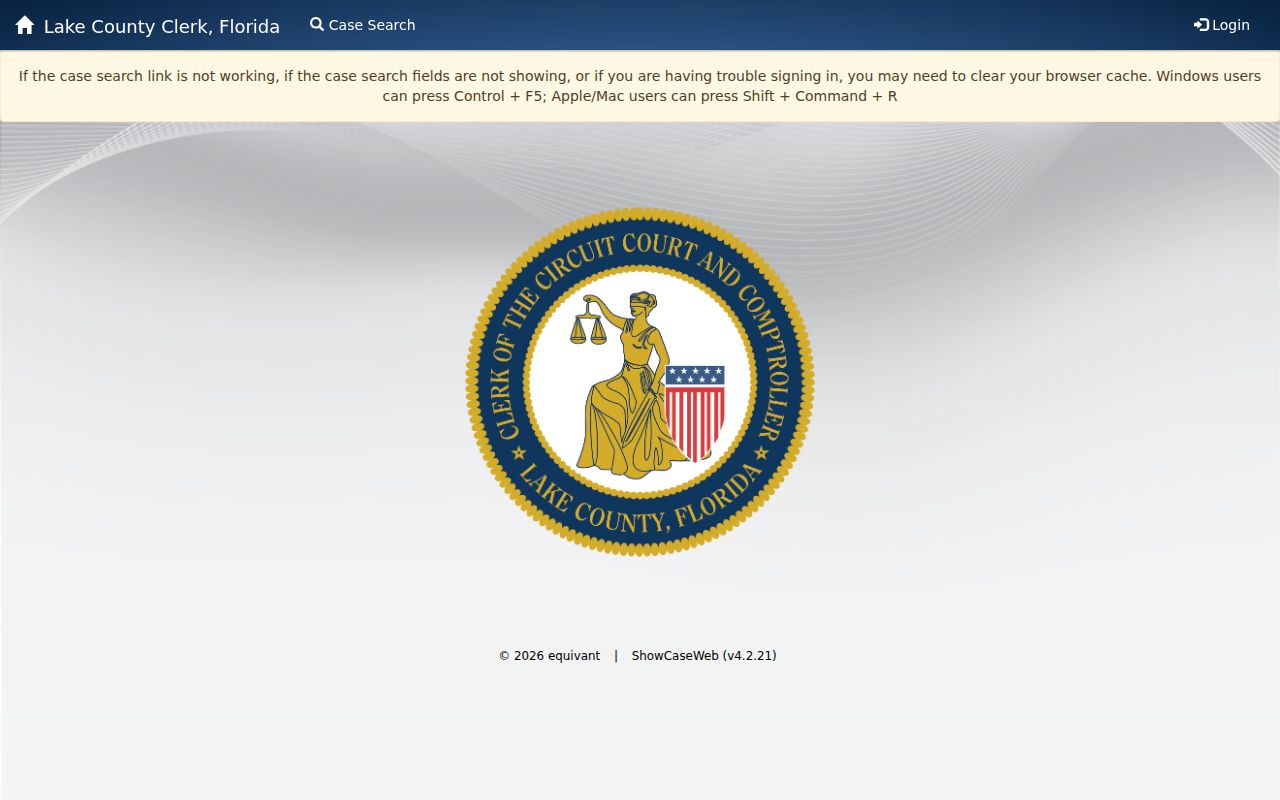
The captured screen shows why a no-result response needs caution: dynamic choices and uncertain historical coverage can stop a search before the Clerk's own file does.
Read Highland Court Results Carefully
A public court result may show the case number, party names and roles, court division, case type, filing date, status, chronological case summary, hearing events, public documents, and financial entries when available. Lake ShowCase also exposes fields such as citation number, incident number, arrest date, judge, and court type on its case-details search. Those fields belong to the case record. They do not certify that a party now lives in Highland.
- Docket
- The dated list of filings and events in one court case.
- Index versus image
- An index points to a record; an image displays the filed page itself.
- Certified copy
- A copy authenticated by the records custodian for formal proof.
- Disposition
- The recorded way a charge, claim, or case was resolved.
Juvenile, sealed, expunged, adoption, protective-order, and other confidential material may be hidden or redacted. Indiana Administrative Rule 9 governs court-record access, while lawful expungement under IC 35-38-9 can remove a matter from public view. Absence from the public screen is therefore not proof that no file ever existed.
Confirm a Highland Resident Match
Same-name errors are the chief risk when checking a Highland resident. Preserve initials, former or maiden names, suffixes, and spelling as each source gives them. Then compare at least two independent anchors. Useful pairs include a name and birth date, a parcel ID and legal description, a case number and party role, or an obituary's relatives and date.
- Search the XSoft parcel roll by owner or known address. Record the situs address, mailing address, parcel ID, legal description, and data date without calling the owner an occupant.
- Check IndianaVoters only when exact name, date of birth, and Lake County are known. This is a one-person status tool, not a street list.
- Search MyCase and ShowCase with name variants, court, status, and date controls. Compare case details with the independent address or date.
- Use an obituary, marriage record, probate filing, business role, or license only for the fact it states. Label each connection current, historical, recorded, or indexed.
- Ask the custodian for a certified copy when the record must carry official authentication. Stop if the match remains speculative.
A Highland situs address is the physical parcel location. A tax mailing address can be elsewhere, and a registered-agent address may be a service office. The compact town also sits beside Hammond, Munster, Schererville, and Griffith, so city labels and county offices can enter the same trail. Exact fields should not be flattened into one claim.
Confirm Highland Voter Status
IndianaVoters asks for first name, last name, date of birth, and county. Choose Lake County for a Highland registration check, enter the name as held, and leave any suffix out of the last-name box. The portal can return registration and polling information for one matching voter. It has no ordinary ZIP browse, street-wide download, or household search.
A no-match can reflect exact spelling, an initial, a recent move, inactive status, a county choice, or a protected record. The Lake County election office is the fallback for process questions. Eligible requests for an existing voter-file report use State Form VRG-24 and its purpose attestation, while the public individual screen remains the safer tool for checking one person.
Protected addresses. Indiana Address Confidentiality Program participants' voter names, addresses, and identifying data are confidential except through the narrow official exceptions.
Note: A voter match confirms the election record presented by the portal, not every member of a Highland household or a permanent address.
Highland Vital Record Checks
Birth and death copies for qualifying Lake County events come through the Lake County Health Department Vital Records Division. Marriage-license copies come from the Lake County Clerk, while divorce decrees belong to the court file. These are separate channels. A modern certificate is not an open name directory, and eligibility, identification, application, and payment rules apply.
Indiana changed the public birth and stillbirth threshold in July 2025. The current policy opens those records on or after 99 years, although some older local pages still mention 75 years. Death genealogy materials generally use a 75-year threshold, subject to the application packet. Ask the custodian which current rule and form govern the event year.
The official county page presents local mail and in-person routes, along with the authorized online ordering path.
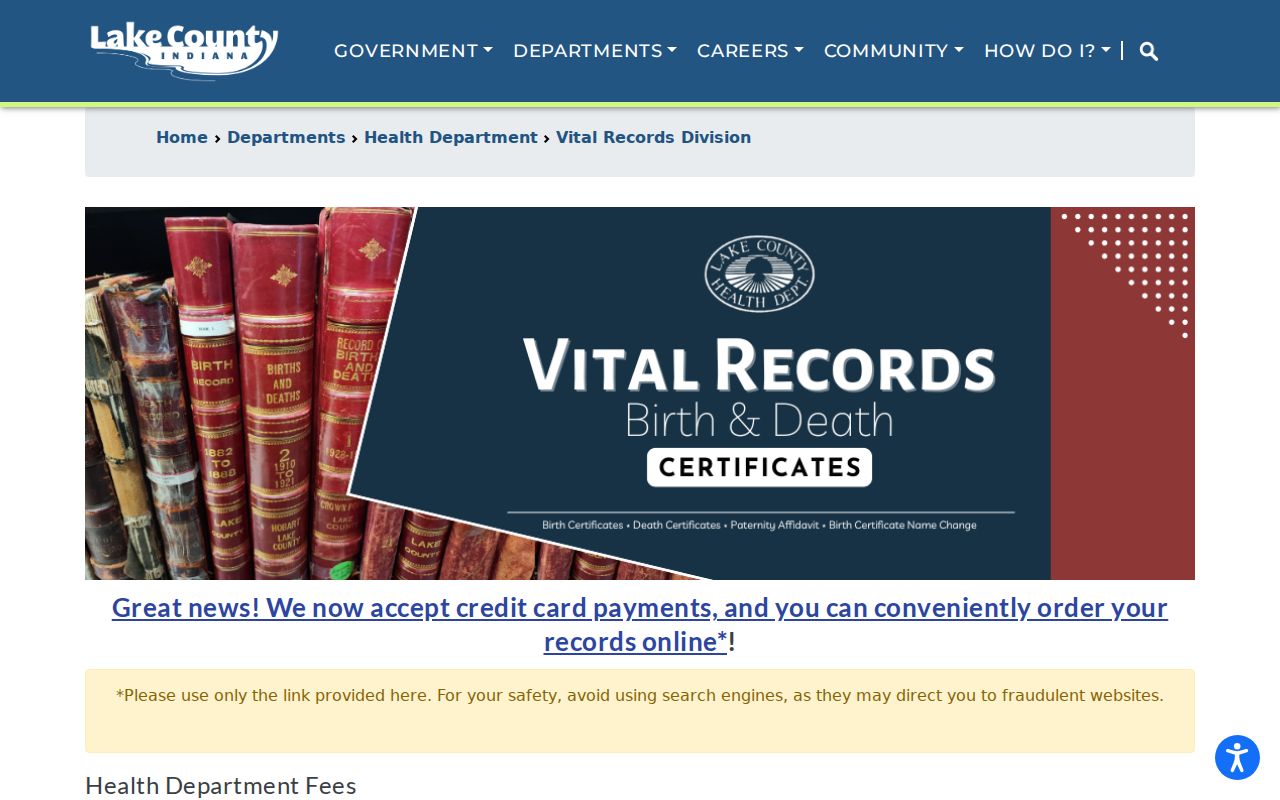
The screen is most useful for choosing the correct custodian and application. It should not be treated as a public index of Highland residents.
Reconnect Through Highland Records
An heir search can begin with LCPL's obituary indexes, then move to a Lake probate case by decedent name. A public docket or certified filing may name the personal representative or heirs in the role the record gives them. Recorder and INBiz records can corroborate a parcel or entity connection, but sensitive addresses from estate papers should not be republished.
Birth-relative searches follow a different path. Indiana adoption files are sealed, so public-record guessing is the wrong method. The Indiana Adoption Matching Registry accepts eligible adult adoptees, adoptive parents, birth parents, birth siblings, and qualifying relatives under its stated proof rules. Registry service is free. State forms support identifying-information requests, medical history, and a birth-parent contact preference. Trained confidential intermediaries can assist a lawful reunion while the underlying adoption files remain private.
Former classmates are best traced through yearbooks, school histories, newspapers, and reunion material. Such a source proves a dated school connection, not a present Highland address. That distinction keeps a reunion search accurate and respectful.
Check Highland Public Affiliations
INBiz can search a business name, ID, filing number, registered agent, governing person, street, city, or ZIP. A result may show entity status, public roles, filings, and addresses. The Indiana Professional Licensing Agency similarly supports name, profession, license number, status, city, county, and ZIP fields. These databases establish a filed role or credential, not a person's home.
Highland contractor records add a town channel. The public application records the trade, company, licensee, references, address, bond, insurance, and approval facts, but no searchable local license register was located. Ask the town for a specific existing license or permit under the Indiana Access to Public Records Act rather than requesting a new all-residents list.
Business records help distinguish two people with the same name when a known entity, middle name, city, or role also matches. Stale filings and service addresses remain common stopping points.
Highland Resident Lookup Limits
Public systems do not disclose a complete Highland household. Renters, utility customers, delivery data, driver addresses, protected voters, sealed court files, and private-account information may not be open. Commercial people-finder products compile public and licensed data, but their dates, duplicate-name handling, and accuracy vary. An official source with a clear date and keeper is stronger evidence.
Indiana APRA applies to existing public records. A focused request can identify a permit, case file, recorded report, date range, and desired copy format. An office need not create a new list. If access is denied, ask for the statutory basis and consult the Indiana Public Access Counselor. Corrections belong with the office that maintains the disputed source.
Lawful use. Use a Highland resident lookup for legitimate personal research. Never use a name, address, or record to stalk, harass, threaten, or harm anyone.